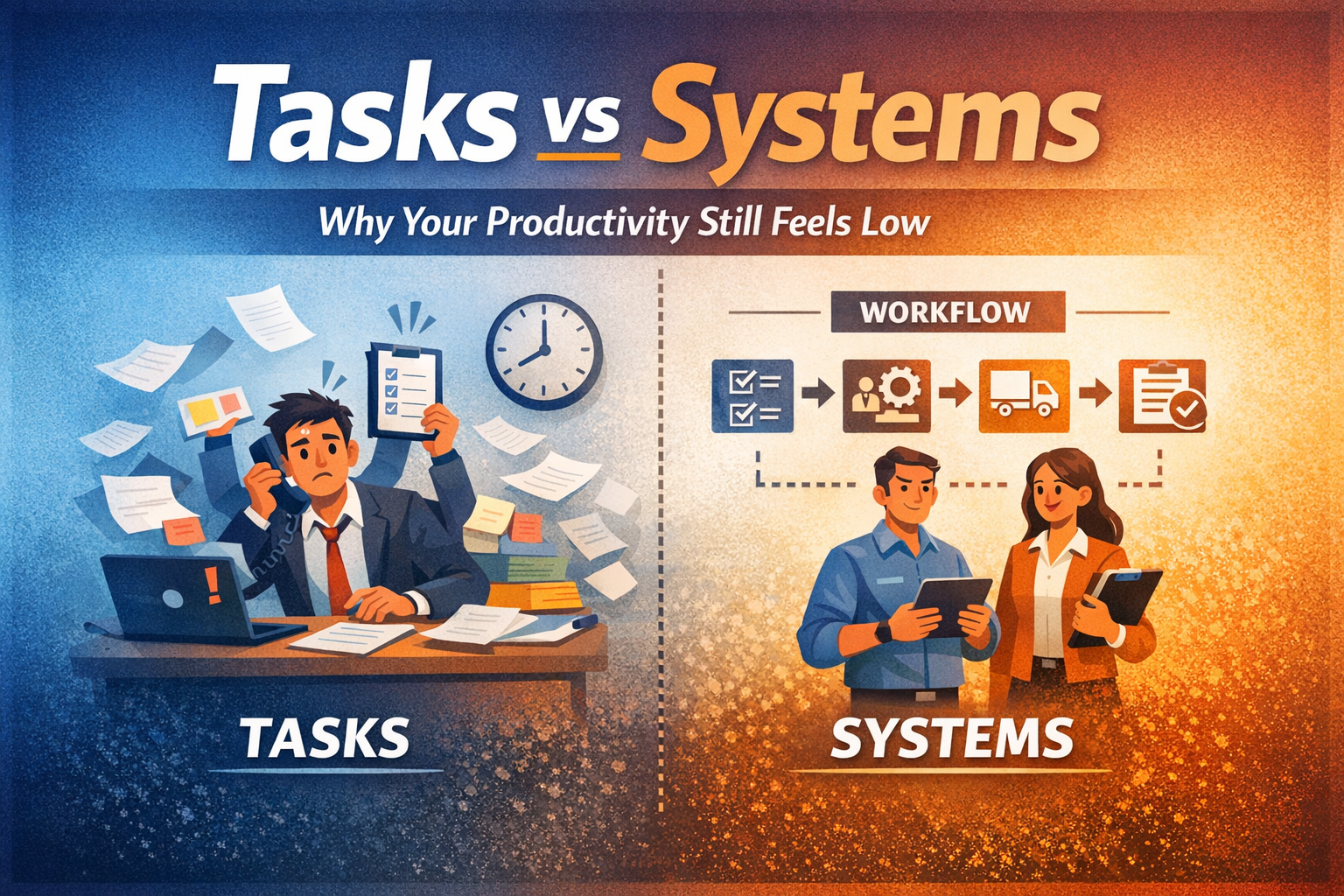

Tasks vs Systems: Why Your Productivity Still Feels Low
Running a business often feels like a constant race against time.
You work long hours. You complete tasks every day. Yet progress still feels slow.
In reality, productivity improves when work is supported by systems.
Understanding the difference between tasks and systems can change how your business operates.
What Is a Task?
A task is a single action that needs to be completed.
Examples include:
- Replying to a customer message
- Creating an invoice
- Packaging an order
- Posting on social media
- Calling a supplier
Tasks are important because they move work forward. However, when a business only relies on tasks, operations become unpredictable.
For instance, imagine a founder who manually responds to every customer message. The task gets completed, but the process depends entirely on that person being available. Over time, this approach creates pressure and slows growth.
What Is a System?
A system is a structured process that ensures tasks happen in a consistent way. Instead of relying on memory or individual effort, systems define how work moves through the business.
For example:
- Customer inquiries follow a response process.
- Orders move through a defined fulfillment workflow.
- Team members know exactly who handles each stage.
As a result, the business runs with clarity rather than constant supervision.
Why Many Businesses Stay Trapped in Task Mode
Many growing businesses operate in task mode because it feels faster at the beginning. Founders simply handle everything themselves.
However, this creates several problems:
- Work depends on one person
- Tasks get repeated unnecessarily
- Team members lack clarity
- Decisions slow down
- Growth becomes stressful
Eventually, the founder becomes the system. Every decision, every process, and every task flows through them. This situation limits scale.
The Difference Between Tasks and Systems
The difference becomes clear when you compare how work happens.
Task approach task-focused
- A customer places an order.
- The founder checks WhatsApp.
- They confirm the order manually.
- They remind the team to prepare it.
System approach system-driven
- A customer places an order.
- The order enters a structured workflow.
- The responsible team member receives the task automatically.
- The process moves to fulfillment and delivery.
In the second scenario, work moves smoothly because the system guides execution.
How Systems Improve Productivity
When systems are installed, productivity improves for several reasons.
- First, tasks follow a clear sequence. Team members know what happens next.
- Second, responsibilities become defined. People understand what they own.
- Third, decision-making becomes faster because processes are already documented.
- Finally, the founder no longer needs to supervise every action.
Instead of working harder, the business starts working smarter.
Simple Steps to Move from Tasks to Systems
If your business feels chaotic, start with small improvements.
- Begin by identifying the most repeated tasks in your operations.
- Next, document the steps required to complete them.
- Then assign clear responsibility for each step.
- Finally, create a simple workflow that shows how tasks move from one stage to another.
Even basic documentation can dramatically improve clarity.
Why Systems Matter for Growth
Growth without systems creates confusion. More customers bring more pressure. More team members create more coordination challenges.
However, when systems exist, growth becomes manageable. Workflows guide execution. Teams collaborate more effectively. Founders focus on leadership instead of constant problem solving.
Final Thoughts
Tasks keep a business moving. Systems make a business sustainable.
If your daily work feels scattered, the issue may not be effort. The real problem could be the absence of structure.
Businesses grow stronger when tasks are supported by clear systems.
Need Help Structuring Your Operations?
If your business feels dependent on you or difficult to manage, it may be time to install operational systems.
Book a free advisory session with AsystReview your operations and discover what structure your business needs next.
